AN-169 min read
FX Lab
Generate effects, isolate sounds from your own recordings and refine them — with sound DNA, variations and a workspace without leftover junk.
Effects turn loops into tracks: the impact on the one, the whoosh before the drop, the crackle in the breakdown. The FX Lab builds such sounds in two ways — synthetically with one click on a category, or from your own recordings: a door, a bunch of keys, rain on the window. Both can be mixed, refined and taken with you as a WAVUncompressed audio format. The devices export at 48 kHz and 32-bit float — lossless, with headroom for further processing.More in the handbook →.
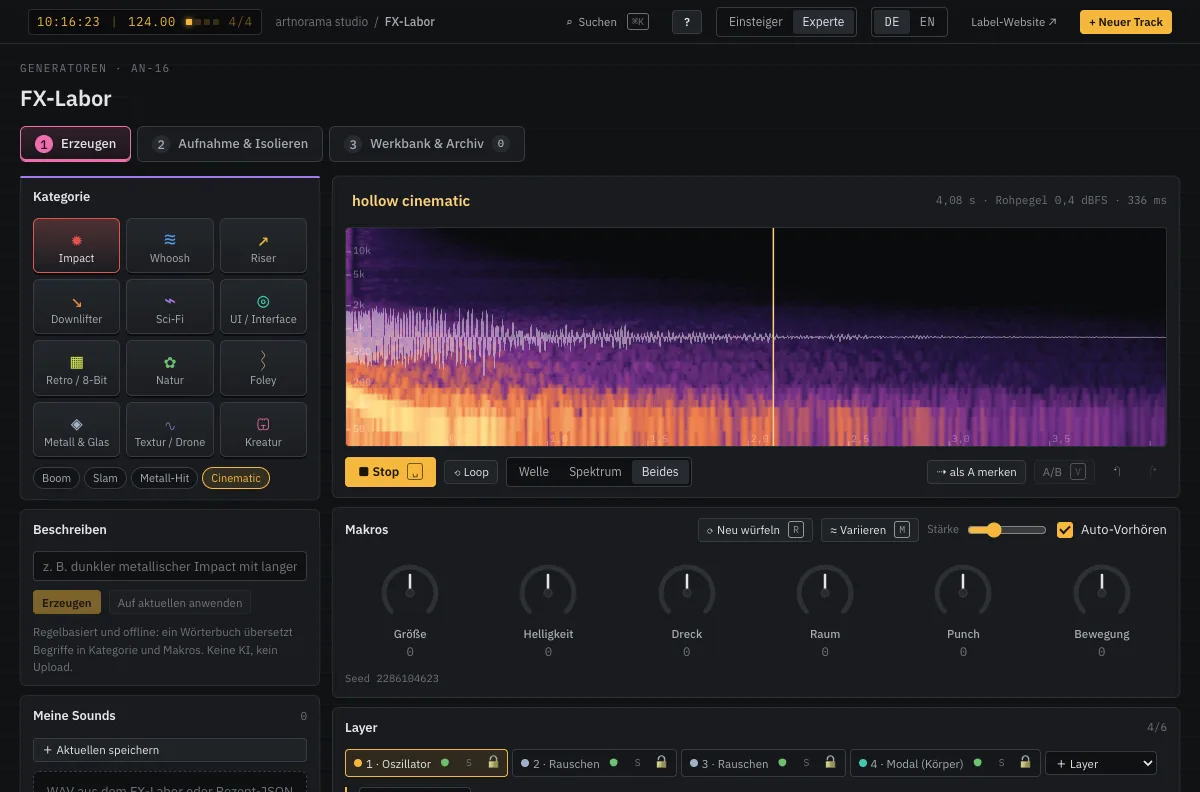
Create
Layers and the FX chain
IntermediateA sound is made of up to six layers — typically transient, body, tail and texture. Each layer has an engine, an envelope (attack, hold, decay, curve), pitch with glide, a filter with LFO and drift. A lock protects a layer when rolling: the perfect sub boom stays while the rest is rebuilt. Then the sum runs through EQ, saturation, crusher, delay, reverb and stereo width.
| Parameter | Range | What for |
|---|---|---|
| Oscillator | sine … pulse | Sub booms, lasers, retro jumps (jump in semitones after x ms) |
| Noise | white, pink, brown, S&H, crackle | Whooshes, wind, rain, fire, 8-bit explosions |
| FM | ratio 0.25–16, index | Bells, zaps, metallic overtones |
| Modal | wood, metal, glass, bell, membrane | Resonances of a body — knocks, anvil, glass |
| String | damping, brightness | Plucked strings and tubes |
| Recording / granular | position, pitch, grains | Your takes from the workspace — directly or as a GranularSound is split into many short grains and redistributed — any recording becomes clouds and pads.More in the handbook → cloud |
Isolating recordings
Sound DNA and variations
IntermediateSound DNA measures a recording — fundamental and partials, attack and decay, brightness, noisiness — and builds a synthetic twin from a resonant body and filtered noise. The slider blends between recording and synthesis: half real, half built, and the synthesis can be bent freely. For games and lively percussion, “Variations” creates eight Round robinSeveral slightly different versions of the same sound played in turn — against the “machine-gun effect”.More in the handbook → versions that keep a minimum distance — no two sound the same.
Little leftover junk
- Imported files are only read, never stored — at most a ten-second selection is kept.
- Isolating is non-destructive: settings are stored, not new audio files.
- Synthetic sounds are recipes of a few kilobytes. The exported WAV carries its recipe — dragged back into the lab, it is editable again.
- The workspace has fixed limits (24 takes, 150 MB). Leftovers — already saved or unused for two weeks — are flagged; you archive them or delete them after confirming.
- Space
- Play/stop
- R
- Roll again (locked layers stay)
- M
- Vary
- V
- A/B — when isolating: original ↔ isolated
- ⌘Z⇧⌘Z
- Undo / redo
- ←→Enter
- Move the cutting range, accept
Try it yourself · AN-16
Tap a category — and on the right, pull the knocks or the bell out of a noisy recording.
Quick check
How do you tell that the noise reduction is set too strong?
Your progress is saved in this browser.